Search This Blog

Showing posts with label pampanga. Show all posts

Thursday, July 24, 2014

The Dying Traditions of Baryu San Pedru


Baryu San Pedro is the biggest barrio in San Simon. It is maybe the most populated barrio in the town. The establishment of San Pedro as a barrio can be traced back on 1853. Before that San Pedro was just a Sitio named Kutkut (graveyard; to dig).

Kuraldal 2014

As one of the biggest barrio, San Pedro is being visited by people from different locations during its annual libad ilug on May 01. People are not just flocking during the Fiesta, they also come during the annual salibatbat (pinitensya). During maleldo too, people from other barrios are visiting the puni (pasyun). Although the readings in puni are very melancholic and dramatic, the atmosphere, however, is very festive.

But the above mentioned traditions were things in the past. These traditions are slowly dying.


Ing Mamamateng Fiesta – Libad, Laban Gayak, Laban Bangka, Kuraldal Fiesta

When I was kid, I would feel that fiesta is coming once we started to clean the house and gather bulung dalayap which would be used by my mother in making leche flan. During Santa Marya (Apr 29), we would gather leaves and start the annual leche flan making. Then the day after, Vispera, we would wake up around 1am to go to Bayung Palengki (Sampernandu). By that time, pigs are being slaughtered. And you can smell the scent of burning fire logs to be used in boiling the water for removing the hair of the pigs.


During the daytime of Vispera, I would wait for the musikus to start doing their rounds at the barrio. I am lucky since our house is near the elementary school. I can see the musikus preparing. Around 9am, they would start to walk the long road of Baryu San Pedru. They would head first to Paroba (going to San Juan, San Simon) then to Control Dike and then to Pangulu (going to Sta. Rita, San Luis). The weather was really hot during those time but they could find shade under the GAYAK (street garlands).

Labang Gayak is one of the traditions being look forward to by the residents. The main street of the barrio is being decorated (extravagantly) by the various youth clubs i.e SPYC, Paradise (which was termed from Spur Dike), Genius, Timac, etc. Months before, members of the club and residents belonging to the clubs would start to prepare. One can see that they were still awake until 3am just to finish the gayak. They would want to win and be crowned as  the best ‘club’ in street decoration. In addition, one can see that street is clean. Moreover, the designs are being accompanied by Christmas Lights (or any other lighting). The competition is really on but it is a friendly one. The perennial winner for the competition is Paradise.

Festivity was really in the atmosphere. This festivity would reach its climax once we reach May 01. 

As early as 6am, masses are being held at the bisitas. People are jam-packed. Bisitas is really crowded as early as 6am. Crowd would increase as 10am draws near. Around 9AM the patio of bisitas will  become crowded. As far from the patio, you could smell the scent of Sampaguita coming from the andas of Apung Iru. Everyone would gather near the andas of Apung Iru. They are waiting for the mass to conclude.

Once the 9am mass is finished, shouting would begin. Bell would start to ring signalling that Apung Iru is leaving Bisitas. 10-minute-ringing-bell, candles, shouts of ‘Viva Apung Iru’, these are just some of the things that you would observe after the 9am mass. (King kaorasan ning 10:15 anggang 10:30 ilual da ne ing Libad). 

Kuraldal would happen at the street. A 5-minute-walk from Bisitas to Tumana (where the lantsa is docked) became 30-minute-walk. Everyone is shouting Viva Apung Iru. The never dying Decolores adds festivity to the kuraldal. During this kuraldal, the andas of Apung Iru is being pushed forward and being pulled backward. From children to senior citizens, people were rotating the andas. They are accompanying Apung Iru on his journey to Tumana where he would ride the Lantsa. Approximately 11:00 – 11:30 the libad would commence.

Seated on the uppermost part of the decorated pagoda, Apung Iru would roam the Ilug Kapampangan (San Pedro, Sta. Rita, San Juan). Accompanying the Lantsa are the decorated bangkas from various clubs, barangays and individuals. Yes, there was also a competition for the bangkas.

Bangkas are decorated with Key, Crown, Rooster, and Scepter. These decorated bangkas are encircling the Lantsa. They were accompanying Apung Iru on his annual journey on the Ilug Kapampangan. Judges during the Bangka Competition are carefully inspecting the design and the execution (if they are far from the lantsa). People residing the river banks (Sta. Cruz, San Nicolas, Sta. Rita, San Agustin, San Juan) are standing near the riverbank to watch the Libad. They are throwing foods onto the river. (The same scenario is being practiced at Apalit Libad on Jun 28 and Jun 30).

The five-hour libad would dock at Tumana again around 4PM. After Apung Iru is seated on his andas, another livelier kuraldal would occur. Old people are the one who would carry the andas. They are the one dancing, shouting and spearheading the kuraldal. If the kuraldal during the morning took about 30 minutes to finish, the kuraldal during the afternoon would last one hour or so. People would try to slow down the pace of Apung Iru’s journey back to bisitas. People are dancing bare footed. They are all wet as people sprinkled each other with water.


Once the one-hour kuraldal subsided after Apung Iru was taken back to Bisitas, you could see the old people with teary eyes and with happy faces. Another festive libad and kuraldal had concluded. Another fiesta was about to finish. These old people would accompany Apung Iru until the last hour of the day – until the long procession would finish.


This is how festive our fiesta was. There were no quarrels. There were no political-agenda. Streets were really decorated. Bangkas were many. Patron saints of the neighboring barrio are invited to participate during the Libad. The pagoda was well decorated; and people were marching forward and dancing during the kuraldal with one thing in their mind – accompany Apung Iru on his once-in-a-year journey.


These were the things in the past which I was fortunate enough to see, experience and savor. These are the things in the past which people like me are longing to return. These are the things in the past which we will continue to act for it to happen again. We are fortunate enough to see and feel it.  But are the youth and people today fortunate enough to see these things the way we saw and felt them?


Thursday, June 19, 2014

Viva Apung Iru! Ninu i Apung Iru?

Apung Iru ning Apalit
Photo courtesy of Flickr
Libad ng Apung Iru is fast approaching and the people from the Pampanga Riverbanks, especially our kabalens in Apalit, are now preparing for this much anticipated river celebration in honor of Apung Iru. June 28 – 30 is the days to remember for the Apalit Town Fiesta. The titular patron of Apalit, Pampanga is Saint Peter (San Pedro) or most famously called Apung Iru. But who is Apung  Iru? Is Apung Iru the Kapampangan name of San Pedru?

In the search for the real identity of Apung Iru, I came across in the article from Wikipedia. Kapampangans has interchangeably used Apung Iru to the name San Pedru (Saint Peter). Most of the Kapampangans today will recall the name San Pedru when they hear the lagiu (name) Apung Iru. Most, if not all, of the barangays which have the name San Pedro in their barangay name use Apung Iru for San Pedro. (Blogger’s barangay is San Pedru from the town of San Simun. People of this baryu will call San Pedru as Apung Iru.)

If one will dig deeper, the word Apung Iru has already been Christianized. Long before the Spaniards came our nunu (ancestors) have already known Apung Iru. They have already celebrated the Libad Ilug in honor of Apung Iru. If Apung Iru is not San Pedru who is he? Or who is she?
Tradisyunal a Basaan Piestang San Juan
***
Kanitang anak ku pa kaibat kung sinimba ning alas-otsung misa keng Baryu San Pedru kukutang ku palagi kang ima ku itang makasulat ketang dalig gulut bisitas. Ngana nitang makasulat “Viva Apung Iru!” ketang lalam atyu ya ing banwa. Nung 1999 kanita 1999 ya. Keng tutuking banwa palitan da neman. Angga ngeni maakit ya pa itang dalig a ita. E pyesta nung e me akit ita.

***

Pre-hispanic Kapampangans worshipped many deities/gods like Apung Suku, Apung Malyari, etc. One of the deities known to them is Apung Iru. Yes, Apung Iru is a pre-hispanic deity of Indung Kapampangan. Apung Iru is ‘often visualized as gigantic crocodile that support the earth on its back.’ Apung Iru (which is a dapu (crocodile)) is situated under the great World River. Apung Iru is a great cosmic crocodile. The word ‘Iru’ is mostly likely came from the word ‘Ilug’ which means river. (The blogger is not a linguist and has no formal background on the contraction of words. The reference for this contraction is “Quests of the Dragon and Bird Clan by Paul Kekai Manansala p245 – 246). Thus the word Apung Iru when translated is “Lord River or Lord of the River” (The word Apu; Apung has a lot of meaning in the Kapampangan language).


Dapu (Crocodile)

***
Kanita na aganaka
Ning babai sinabi na
Itang limusan ming matua
Apung Iru ing lagyu na

Gozu ng San Pedru (XV)
***

Libad Ilug
Photos courtesy of Apo Iru
On a conversation of the blogger with the Kapampangan Culture Advocates, they have mentioned too that Apung Iru is Apung Ilug. Apung Iru is also Munag Sumala (Dawn; Pampanga River) who resurrect in the arrival of Lakandanum (Water God). Munag Sumala is the first child of Apung Suku. Munag Sumala is the wife of Manalastas. Also Munag Sumala had an illicit affair with Lakandanum. In addition, Munag Sumala died during the height of Sun’s anger which coincides with the Viernes Santu of the Catholics.  The resurrection of Apung Iru (Munag Sumala) marks the Kapampangan Bayung Danum. This is the Kapampangan New Year. Bayung Danum will signal the start of the planting season

During the resurrection of Apung Ilug/Munag Sumala (after the arrival of Lakandanum), Kapampangans will celebrate. This celebration of the Kapampangan is the Libad Ilug. In addition, during the Bayung Danum, Kapampangans will throw food onto the river. The practice of throwing foods onto the river is a sign of offering to Indung Tibuan (Mother Earth) so that it wont look for food and earthquakes wont happen.


Pamandilu balang Libad Ilug
***
Apung Iru talus mi ngan
Sigasig mu ing kaligtasan
Tune lugud milalablab
King balayan mung kaluguran

Himno San Pedru

***

Scene when Apung Iru is being taken to Lantsa
(Apalit)
Photo courtesy of Apo Iru
On other accounts, Apung Iru also caused the flooding if she is angry.  And in order to appease the Apung Iru, fluvial procession and throwing of food onto the river is being practice during Bayung Danum – month of June. Also during the Bayung Danum and Libad Ilug people sprinkle each other with water.


There are some practices that the blogger has observed during the Libad Ilug (San Pedru, San Simun) and Apalit, Pampanga. In San Pedru, San Simun, after the kuraldal and Apung Iru has been put into the barge (lantsa) people will take water from the river and take it home. Then they will sprinkle it to their body and sometimes use the water when they take a bath. They believe that the water was blessed by Apung Iru (San Pedru in this case). Meanwhile in Apalit, Pampanga, when Apung Iru’s image is being taken to the lantsa people are waving branch of leaves example guava leaves. They believe that these leaves when boiled can cure illnesses.


Kuraldal Keibat Libad (SP, San Simon)
Photo by Lhian Rogodon
Before the libad ilug of Apung Iru (San Simun) will start, there is always kuraldal and the people are shouting Viva Apung Iru. The same will also be practiced when the libad is ended and the image of Apung Iru is being return to the chapel.

It can be stated that the Kapampangans did not let their pre-hispanic practices die. They could have incorporated their practices to the Catholic Religion in order to preserve them or vice versa. As kapampangans, we should preserve and continue to practice these traditions. These traditions had defined us and they will define us. 

Cover Photo of Apo Iru


Viva Apung Iru
Apung Iru o i San Pedro?


____________________
References:
http://en.wikipedia.org/wiki/Apalit,_Pampanga
http://sambali.blogspot.sg/2004/12/apung-iru.html
http://hau.edu.ph/kapampangan_center/events/index.php
Apung Iru San Pedro San Simon Facebook Page
Apo Iru Facebook Page
Gozu ng San Pedru (translated from Kulitan Script of J. Aboyme) taken from Kulitan Facebook Group
Quests of the Dragon and Bird Clan by Paul Kekai Manansala p245 – 246
Dalit ng Sinukuan by Michael Raymon Pangilinan
Kuraldal Atlung Ari & Libad Bangka nang Apung Iru: Beyond the Revelry
Pineda, L. & Aboyme, J. Personal Communication. April 05 2014
Pineda, L & SPYM. Personal Communication. April 29 2014
Pineda, L. & Pangilinan M. Personal Communication. April 30 2014


For corrections and additional information please leave a comment below.


Thursday, May 22, 2014

Pandi ning Indung Kapampangan (Flag of the Pampanga Nation)

Pampanga had been a nation long before the Philippine Archipelago has been a ‘nation.’ It has its own culture, language, mythology, philosophy, political structure and a flag. A flag symbolizes a distinct country or nation (Wikipedia.org). It represents the belief, the history and the people of the country.


Salagintu
Courtesy of Siuala.com

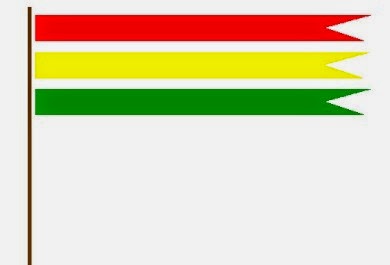
Pampanga’s flag has the color of kundiman (red), aluntian (green) and dilo (yellow). The meaning has varied depending to the perspective of your source.

Maniago's Military Flag
Courtesy of Watawat.net
Based on historical accounts, Francisco Maniago has used the color red, yellow (golden) and green during the Kapampangan uprising of 1660. The salagintu (red, yellow and green) or sometimes called golden beetle was the color used by the Kapampangan nobility during the Spanish time. The color of salagintu was also used by the secular clergy in Pampanga way back then.  Even the Christianized festival i.e Apung Iru Libad in Apalit uses the three colors.

Moreover there were allegations that the clan of Baluyut, who were in priesthood back then, used the three colours in their insignia. They also use the salagintu color to decorate the churches, streets and festivals. Also, the Pamintuan family used also the salagintu color to represent their clan whether in the army or in the political arena. Meanwhile in 1950, the Archdiocese of Pampanga adopted the salagintu color in its insignia.

 
Annual Libad Ilug of Apalit
Courtesy of Apalit FB Page
At the present, the seal of Pampanga still bear the color of salagintu. Also, the town of Apalit, Mexico, Sto. Tomas (to name few) has also added the salagintu color in their official seal.

Official Seal of Pampanga
The Significance of the Salagintu Color
The following relevance and meaning of the salagintu came from various sources.
Terms: Kundiman – red; Aluntian – green; dilo/gintu – yellow


(1) Paroba, Pangulu ampong Bunduk Alaya

The color kundiman represents the Pangulu (upper Pampanga); the color aluntian represents the Paroba (lower Pampanga) and the color dilo represents Mt. Arayat.

(2) Alti, Danum ampong Aldo

According to local historian and Kapampangan Culture advocate Mike Pangilinan, the kundiman of the Kapampangan flag represents the alti (lightning). ‘Alti’ is the authority/punishment/energy of Bapung Aldo (Apung Suku). Kundiman represents the color of destruction. Meanwhile aluntian represents the ‘uran’ (rain) and ‘sibul’ (spring of water) which comes after ‘Alti.’ Aluntian represents the water which heals the land and the people. Dilo represents Bapung Suku/Apung Suku, the golden sun. Apung Suku is the one who mediates ‘alti’ and ‘danum.’


Libad Ilug Dela Pas
Courtesy of LOI Photography
(3) Katapangan, Kasipagan and Kasugian

In addition to the meaning stated above salagintu color also represents Katapangan, Kasipagan, Kasugian. These meanings were defined by the Catholic Church when they adopted the Kapampangan Colors. Kundiman represents Katapangan (bravery), Gintung Dilo represents Kasugian (nobility). And Aluntian represents Kasipagan (Industriousness).


(4) Babo Pampanga, Lalam Pampanga ampong I Yesukristu

In the website watawat.net, the salagintu color represents Pampanga and Jesus Christ. Kundiman is the color of Upper Pampanga. Aluntian is the color of Lower Pampanga and Dilo is the color of Christ.

(5) Alta Pampanga, Bajo Del Pampanga ampo deng Dayatan

The colors’ of the Flag of Pampanga has another meaning. Kundiman is the color of the Alta Pampanga (Upper Pampanga). Red was given to Alta Pampanga due to the color of the soil and their product – sugar. On the other hand, Aluntian represents Bajo Del Pampanga. Aluntia is Bajo Del Pampanga’s color due to the abundance of rice fields. And Dilo again represents Kasugian (nobility).
 
Kapampangan FB Cover Page
Created by Alwyn Balingit
On the personal communication of Pineda and Pangilinan, Pangilinan mentioned that there are other colors/flags that represent Pampanga and its culture. There is the flag with Maputi (white), Kundiman (red) and Matuling (black). Maputi is the color of Ugtung Aldo, Bayang, Apung Sinukuan a Manlasak (Apung Suku who destroys) and Apung Manalaksan. Kundiman represents Apung Maliari and Apung Mangkukuran. Lastly, Matuling is the color of Tau (people).

If the flag is hang horizontal, Kundiman is on the top of Dilo; Aluntian is on the bottom. However if the Kapampangan Flag is vertically oriented, most of the flags seen have Aluntian near the Pole, Dilo at the Middle and Kundiman at the right of Dilo. There has been no concrete and structured guideline as to the orientation of Kapampang Flag.

Kapampangan Flag at Candaba
Courtesy of Fr. Greg Vega FB account
A flag can be just a flag. But let us dig dipper on what it represents especially the Pandi ning Pampanga. Let us hang our Flag and be proud that we have this flag (older than the Philippine Flag) which represents our Kapampangan identity!


Sources:
http://en.wikipedia.org/wiki/Pampanga
Pineda L. & Pangilinan M. Personal Communication. May 16 2014.
Pineda L. & Aboyme J. Personal Communication. April 12 2014.
Facebook Page of Apo Iru
Facebook Page of Apalit
Facebook Page of Pampanga

For corrections and additional information, kindly send your information at lester.pineda78@yahoo.com

Wednesday, May 14, 2014

Siuálâ ning Pámangulait: Nínu na Íng Kapampángan King Baiung Panaun?

Isúlat ke iti king amánu da reng dáiû (English). Masakit man para káku na alî king Amánung Sisuan ia misúlat iti.

Atin Ku Pung Singsing
Metung Iang Timpukan
Amana Ke iti King Indung Ibatan
Sangkan Keng Sininup
King Metung a Kaban
Me-alaya iti e ku Amalayan

Pampanga, but it is better to say Indung Kapampangan, has long been established even before the colonizers grabbed our lands, branded us with foreign surnames, baptized us with water, introduce occidental religion, philosophy and life style. Kapampangans are proud race for their arts, culture, language and beliefs. But that is the thing in the past. That was the time when our culture is flourishing, when we were proud to say we are Kapampangans and not Filipinos and when we were still aware of our own identity. But now where are the Kapampangans? Where is the once proud race of this archipelago? Where are we now? Where will we be?

Indung Kapampangan
Photo Courtesy of Kapampangan (Capampangan) Facebook Group
Modernization, colonization, commercialization, veneration has drifted away our inner core. Even our very essence of being Kapampangan has been vanishing. This observation is not a product of a deranged mind but a product of the bitter reality. At present we are very proud to shout and show to the world that we are Filipinos.  Can we take a moment to pause and think what we are doing? Kapampangans are not Filipinos! We were and will never be Filipinos! We are Kapampangans! Kapampangan is our nationality not the foreign word which came from the name of the Spanish King! We are Kapampangans! And Indung Kapampangan is our nation. Colonizers acknowledge that Pampanga is Nacion Pampanga. How about us have we acknowledge that Pampanga is a nation? Have we acknowledged that we are indeed Kapampangans not Filipinos?

Mapa ning Pampanga
Photo Courtesy of Jayvie Aboyme (UrbanKapampangan)
In addition to what has been said, another bitter pill of reality that we are seeing now is the death of our language, our dalit, our basultu, our songs and many more! Let us consider Atin Ku Pung Singsing – the most sacred song of the Kapampangans. When I was a kid my maternal grandmother always sang that to me before I play at Gatpanapun. I can still recall the lyrics taught to me by my grandmother not by the Manila-centric books. Although I know how to sing it back then and I know the lyrics I do not know the meaning of it. At present, children do not know this song! They recognize the hymn because schools require or ask them to dance Atin Ku Pung Singsing. But when I asked if they can sing it to me they cannot do it. They can sing ‘Let it Go’, ‘Pusung Bato’ and many foreign songs but not Atin Ku Pung Singsing. This is disturbing. If they cannot sing Atin Ku Pung Singsing, can they still sing Himno Kapampangan?


Kapampángan, sále ning legwan
Kapampángan, sandalan ning katimawan
Kílub ning púsu mi atin kang dambana
Luid ka! Luid ka!
Palsintan ming Kapampángan!


Another point of concern which I can visibly see is that parents do not teach their children the Kapampangan Language. They teach their children how to speak English and Filipino. These languages of death and slavery are not for us! They will never be for us. There are a lot of Kapampangans who know how to speak Kapampangan but do not speak it. They say that the language is too kanto-like and too ghastly. They prefer the languages of slavery and death rather than the Language of their Soul! Meanwhile, the MLT (Mother Language Tongue) which is being implemented by the DepEd is not effective and will not be effective. Most of the teachers who are in this MLT still use Tagalog!

Atin Ku Pung Singsing in Kulitan
Kulit courtesy of Aljon Medina (Aguman Sulat Kapampangan)

In terms of folklore, mythology and the like, most if not all of the Kapampangans are fascinated by the Greek, Roman and Norse Mythologies. They know Zeus, Hercules, Athena, Jupiter, Mercury, Thor and Loki. But do Kapampangan know Galura the bird sent by Apung Suku to clean the land? Do Kapampangans know Gatpanapun? Do they know Apung Suku?

Apûng Sukû mátas ya pin,
Aslag na mapálî mú rin,
Lub ding táu maláut pin,
Ginung Aldo núnû dá rin.
Dalit ng Sinukuan 6:2


There are a lot more to say but the bottomline will still be the same. Where are we now? Where are the Kapampangans now? Are we like the Jews who are lost and longing for the Promised Land? Where are we headed? Are we taking the path of extinction and after such we will just be the lost people who will be written in the Manila-centric books? We are running out of time to save our identity and our nation Indung Kapampangan. The time for us to act like Kapampangan is now.

Pákantadánan támu  ábe
Alâng masias a tinápe king mapálîng kape!